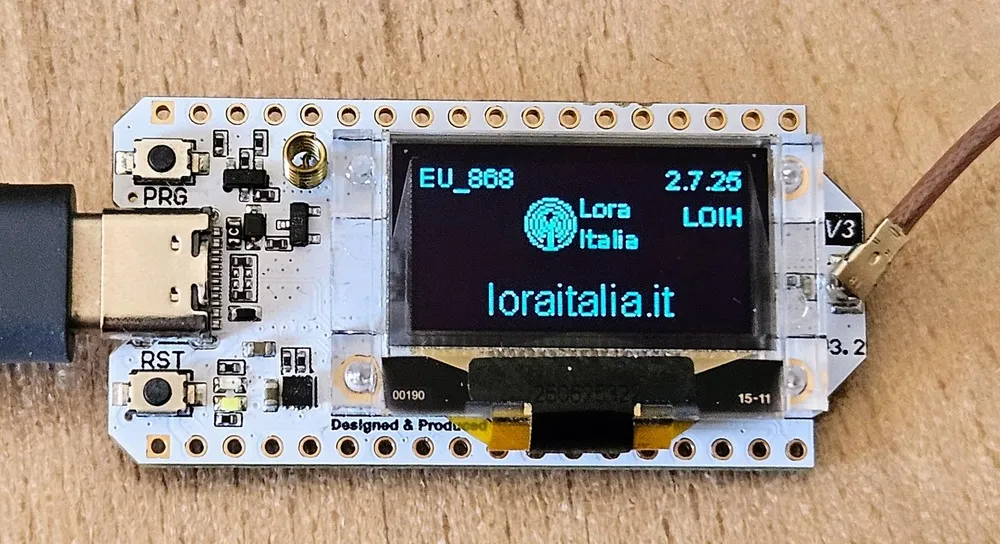
LoRa: what it is and how long-range low-power radio works
What LoRa radio technology is, how its modulation works, how it differs from LoRaWAN, and its main use cases, from IoT to emergency mesh networks.
What is LoRa?
LoRa (from Long Range) is a proprietary radio modulation technique, developed by Semtech, built for one specific goal: transmitting small amounts of data over very long distances while consuming very little power. It’s the opposite trade-off from Wi-Fi or Bluetooth, which offer wide bandwidth but short range and higher power consumption.
A LoRa chip, powered by a simple battery, can transmit for months or years and cover distances ranging from a few hundred meters in an urban environment to tens of kilometers — sometimes over 100 — in line-of-sight conditions, such as between two mountain peaks.
How the modulation works
LoRa is based on a technique called Chirp Spread Spectrum (CSS): instead of encoding bits on a single fixed frequency, the signal is spread across a band of frequencies that “sweeps” over time (a chirp). This makes the signal much more resistant to noise and interference than narrowband modulation, at the cost of a low bitrate.
A key parameter is the Spreading Factor (SF, from 7 to 12): the higher it is, the greater the range and noise resistance, but the lower the transmission speed and the longer the device stays “on air” — which increases power consumption and, in Europe, runs into stricter duty-cycle regulations.
LoRa is not LoRaWAN
This is the most common mix-up, so it’s worth clearing up right away: LoRa is just the physical radio layer, the way bits get turned into radio waves. LoRaWAN is a network protocol built on top of LoRa that defines how devices authenticate (OTAA/ABP), how they talk to gateways and a central network server, and the device classes (A, B, C) with their respective power/latency trade-offs.
Not every network that uses LoRa modulation uses the LoRaWAN protocol, though. Projects like Meshtastic (which we’ll cover in a future article) use LoRa radio as the physical layer, but implement their own decentralized mesh network protocol, with no gateway and no central server: every device can relay other devices’ messages, extending the network’s overall coverage.
ℹ️ In short
LoRa = the radio. LoRaWAN = one possible protocol on top of that radio, built for star networks with gateways. Mesh networks (Meshtastic and similar) are a different alternative, built on the same LoRa radio.
Frequencies: 868 MHz in Europe
LoRa operates in ISM bands (Industrial, Scientific and Medical), license-free but subject to power and duty-cycle limits set by local regulations. In Europe the reference band is 868 MHz, while the US typically uses 915 MHz. No license is needed to transmit, but power limits (typically a few tens of mW) and the duty-cycle constraints set by ETSI regulations must be respected.
Real-world use cases
- IoT and telemetry: agricultural sensors (soil moisture, temperature), environmental monitoring, smart meters, wherever a few bytes a day need to travel from remote locations with no power grid or cellular access.
- Mesh communication networks: projects like Meshtastic let you exchange text messages and position data between devices with no internet infrastructure, useful in the mountains, at sea, or in emergency scenarios where cellular coverage is missing.
- Smart cities: street lighting, waste management, smart parking, where thousands of very-low-power sensors need to occasionally communicate small data packets.
How far does it really reach?
Range depends heavily on context: in a dense urban environment, with obstacles and buildings, you often end up with a few hundred meters to a couple of kilometers. In direct line-of-sight conditions (two elevated antennas with nothing in between), you can easily exceed 10-20 km, with documented records well past 100 km. Antenna type, its height, and the Spreading Factor used matter more than any other single factor.
In upcoming articles we’ll take a closer look at Meshtastic, the most popular open-source firmware for building LoRa mesh networks, compare it with the newer alternative Meshcore, and walk through how to actually join a live Italian mesh network like the Lora Italia project.

Co-Founder & CTO at PAPION. Senior full-stack engineer specializing in React, TypeScript, Node.js, and application security.